Monday, April 9, 2012

H ~ hoppa = hop


God morgon, klass!
Welcome back! I trust you enjoyed your day off with friends and family and that you're refreshed and ready to dig in again. Today's word is a very important word. It's hoppa. Pronounced: h + O as in Oprah + po(w). Or another way is like cuppa, as in I'd like a cup of ... only you're southern and you're Dolly Parton and your explaining the cuppa cake to Olympia Dukakis. Cuppa -c + h. You still with me? You did see Steel Magnolias, right? If you didn't, you'll have to go with the Oprah thing.

Hoppa means to hop. As in on one foot, or onto a train, over a puddle, or a over a fence and into a closed pool to go skinny dipping. (Not that your teacher would know anything about that...but I do have a search function, waaay down at the bottom of my blog. In case you're interested in stories of that nature.) Where was I? Oh yeah, then when you need to explain to the officer what you're doing, you'll have one word, hoppa, to help you. Good luck.

Seriously now, of all the h words available, I chose this one because it's attached to a special memory with my sister. When we visited Farmor and Farfar during the summer, they always gave us their double bed, and slept on a pull-out bed in the den. Their bed was a bit hard to sleep in for us, because of course we didn't just go to sleep. We told stories and giggled and moved around, and pretty soon the bed was in complete disarray.

It had a strange kind of arrangement where on top of a VERY firm mattress there were two-inch thick pads. You made your bed on and around those pads. Swedes don't have fitted, elastic sheets for the bottom. They only have flat sheets. So as you can imagine, if you're goofing around at all, these flat pads slide everywhere. So we invented this method of kinda putting things back in order by grabbing onto the pad, and then doing a sort of froggy-hop thing. Hop, during split second in air, pull pad closer to desired position. Land. You do this over and over again, with lots of giggles.


This picture is from 1975, so it's not one from one of our teenage solo visits.This picture is from the trip the first summer after our move to the US, so I'm 10 and she's 7. It's also an example of that thing I was telling you about: Farmor always buying us the same clothes.  That's her in the picture with us, and those dolls are the ones that lived at her house.  She made sure that we had everything we might ever need so that we would visit often.  Of course we did.  I just couldn't find pictures of us from that time. But I figured out why. My mom is the paparazzi, and she wasn't with us. Farfar took good pictures, but they're all slides.  

Sorry I got longwinded today.  Guess I had a lot to say since there was no post yesterday!  Do you have a special sibling memory you'd like to share?  Did you get tortured, um, blessed with matching clothes?  Have you ever froggy hopped?  I'm dying to know  ;-)

Saturday, April 7, 2012

G ~ gaffel = fork


God morgon, klass!
(G + owed) + (myrrh (as in frankincense, gold and ...)+ gone) + kl + us)! I'm very proud of how well you're progressing!

Today's lesson is fairly practical. You've learned some cool words, but it's not often that you'll need to ask the person you stop on the street, “Where is my egen sommar stuga? Farfar is waiting for me! I have a bil!”

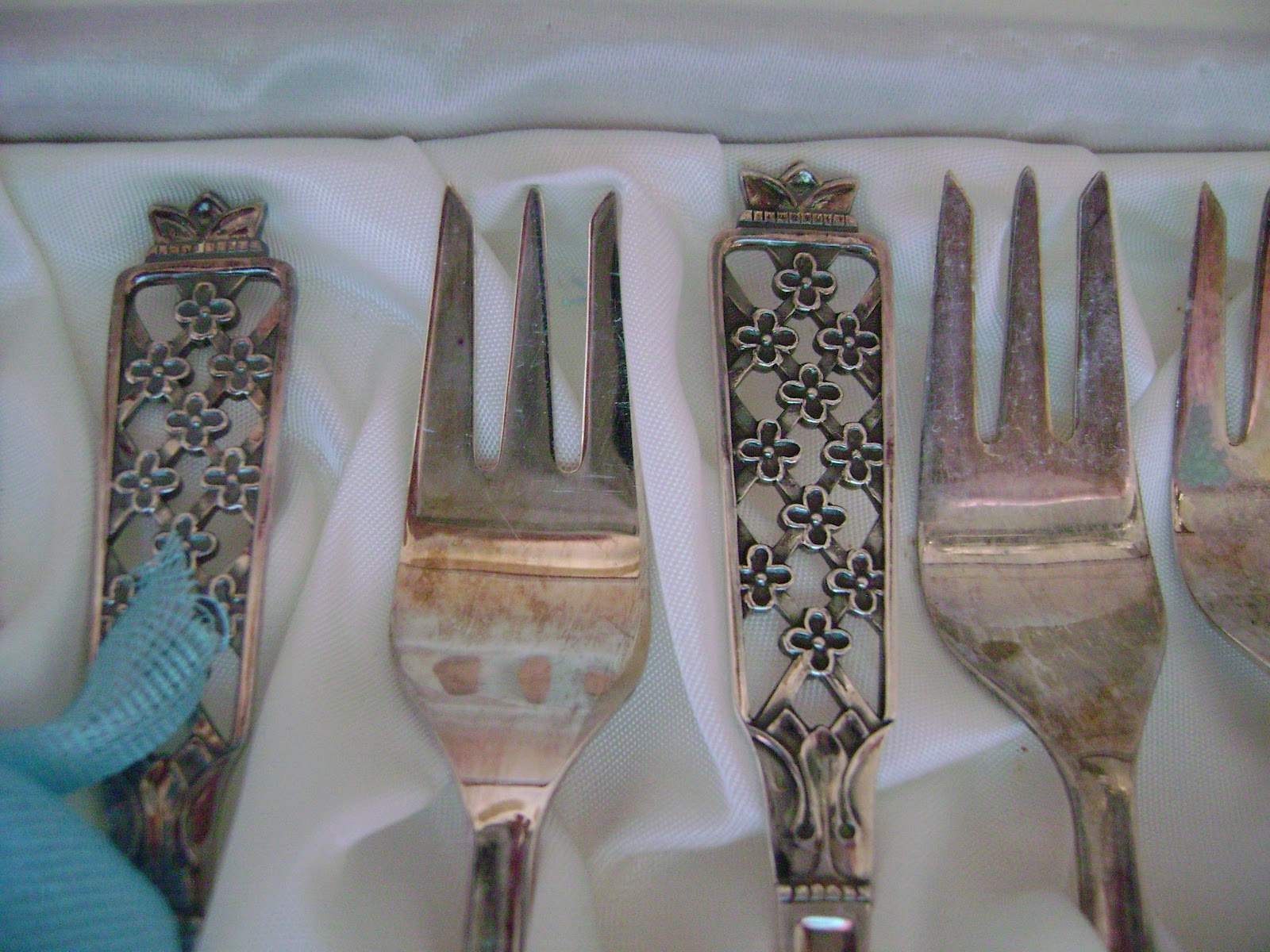
Today we're talking traditions and hope chests, and EATING.  In Sweden, girls don't wait to be engaged to start planning their silverware and china. They choose at a very young age what their pattern is, and then for Christmas and birthday relatives contribute to your pattern, starting with dessert forks and spoons. Today's word is gaffel, pronounced “cuff – c + g, which is guff then just say the letter L. Guff + L. It means fork.


My particular pattern is called “princess”. I don't remember choosing it at all, but I love it. This picture is from one of my birthdays, 13th I think.  There's my sis, and she's holding her spoons, while I have my spoons completed and have some forks.  It's the age difference, that's why she's behind :-) If you closer, you'll see we're wearing matching pajamas.  My grandmother always bought us the same EXACT thing.  Sometimes we had different colors, but they were always the same.  Complete fairness for both granddaughters. 

 Here are some shots of my treasures closer up so you can see the details of the the pattern.  As you can tell, polishing silver isn't one of my gifts.  


For the longest time, I kept these tucked away, saving them for...what?  I don't know what the final thing was that pushed me into using them, but I think it was probably when I read Simple Abundance by Sarah Ban Breathnach.  Her main point is that we need to live NOW.  Not for some day in the future.  Not, "When the kids are...then we can..."  I realized this was my life.  It was half over.  If I was going to use these forks and spoons so lovingly collected for me by my Farmor, now was the time.  So I do.  I eat my yogurt with the spoons.  I pick snowcrab with the forks (they really are tiny, for tiny delicate, Swedish confections.)  I use them.  I think of Farmor, and that makes me smile.

Do you collect anything?  Does your family have a similar tradition?  What do you treasure from your Farmor or Mormor?

Friday, April 6, 2012

F ~ Far = father


Hejsan igen!
Bonus word igen. It means again and is pronounced “eee + yen”. I'm excited about today's lesson because of how well it shows the preciseness of Swedish. Our word today is “far” which is pronounced just like the English word which means a long distance. In Swedish it means father. Not daddy, that is “pappa”. (Oh look, another bonus word, pronounced “pop + po(ndering)”. Far's companion word is mor which I'm pretty sure you can guess is mother. It's pronounced like the English word for windswept, lonely landscape (ala Wuthering Heights – moor). It's casual version, like mommy, is “Mamma” pronounced “mum + ma” as in English for ma, as in ma and pa. Phew. That's a lot of words for one lesson. But, check out what we can do with them!

In English, when referring to the older generation, we say complicated things like, my grandfather on my dad's side. In Swedish, that would be “Farfar”. Father's father. I'll write them out for you. Instead of paragraphs to introduce a room full of relatives, here's all you need. Four words.

Farfar = father's father
Farmor = father's mother
Morfar = mother's father
Mormor = mother's mother

Isn't that just deliciously simple?

I'd like to share my family with you.  Picture quality horrid since these are digital shots of old photos from the seventies which were then glued into a scrapbook and cover in plastic protective sheets...but you'll get the idea.

This first one is my Far, my Pappa.  Taking care of me after I broke my hip getting hit by a car.  I'm nine, and he's holding me up because I had to be vertical for certain parts of the day to keep circulation going or some such nonsense. 


This is my Farmor.  I'm about eleven, I think.  

This is Farfar, I'm 17. 


 I only met my Morfar a couple of times.  He visited us in Sweden in 1972, which makes me 7.  He died unexpectedly of a massive heart-attack in 1974, which was the year we came to the US.  And the reason why.  


This is my Mormor, my Grandma Vivian who lived until she was a week from 98.  She died two years ago. 


 I love my family.  Thanks for the letting me cheat on the postcard thing.  At least it wasn't vacation pictures! Ok, technically some of them were...


Thursday, April 5, 2012

E ~ Egen = one of my very own


Hejsan!
Today's lesson is about ownership. When I was a little girl, two and a half according to my mother's notes, I had a Swedish outfit. I absolutely loved it, and I had a doll who had the exact same outfit. So I, in turn, wanted my doll to have her own doll, just like I did. I wanted her to have her “egen” doll.

Egen isn't easy to translate, which brings up a topic that will become more and more common as these lessons continue. Swedish is a much more precise language than English. They have many single words where to translate the whole meaning effectively, you need a lot more than one English word. Today's word egen is like that. Let's tackle the pronunciation first: e(gg) + (a)gain. The accent is on the first syllable. The best way I know how to translate the full meaning is, “one of my very own”. So what I was saying to my mom was that my doll needed her very own doll in this outfit, just like I had my doll who matched my outfit. So check this out:  


That's me at 2 and a half, holding the doll that's in the next picture...who got her egen docka.  Bonus word.  Bet you can guess its meaning!  

Now to a few housekeeping items.  I've been overwhelmed with the wonderful comments you've left for me.  I usually write an email to everyone who comments on my blog.  Then I visit them.  I'm thinking that's perhaps a bit unrealistic considering the volume of lovely comments, and my co-hosting duties on top of that.  I will respond when I have time, I will visit you back, I'm just realizing that some of that will happen once the challenge is done...Just know how much I appreciate you, and your kind comments, and your encouragement.  I especially like it that so many of you are starting to write Swedish sentences in your comments!  That, my friends, totally ROCKS.


Wednesday, April 4, 2012

D ~ Dala Häst = Dala horse


Hejsan! This is a very common Swedish greeting, pronounced “hey-sun”. It's your bonus word for the day. I had positive comments on yesterday's bonus word, so I think I'll throw some more in from time to time.

Today you're getting more than one postcard. I just couldn't send just one...but the catch is you have to endure the next paragraph of phonics.

Today's lesson is on Sweden's most famous souvenir – the Dala Häst. As you can see, we've encountered our first special vowel, as I explained we would in our lesson on A. The pronunciation is “do(g) + la” “h +(j)est”. That looks confusing, but let me also teach you my method of showing you pronunciation. When I put a letter in parentheses, don't say it. In other words, what we have is dog, but take of the g, so just do+la. The la is as in “lalalalalala” I'm not listening. So you get dola. As for häst, it's just like the word jest, only with an h in front instead of the j.

I know what you're thinking. “Why doesn't she just record herself saying these words???” I tried. All the instructions were horribly complicated and I frankly just don't have time to figure it out. If you know how, PLEASE email me, or leave the info in the comment.

These hästar (that's the plural) are made in only one place in Sweden, in the tiny town of Nusnäs, in the region called Dalarna.  


This is not me, and that's not my Grandma, but there is a picture like this of us in some album somewhere, but I couldn't find it.  These artisans work hard at their craft, and each horse is hand painted.  


Last, but not least, here are mine.  The doll and her story is for another postcard.


Tuesday, April 3, 2012

C ~ cottage = stuga


google image


Welcome back students! You're doing a wonderful job so far in your Swedish lessons! Today's word is stuga which means cottage. It's pronounced like “stew + gah”. When we lived in Sweden, it seemed to me that everyone of my Grandparent's friends had a summer cottage. Bonus Swedish word: summer is sommar! Pronounced “sum + ar” (ar as in argument.) I asked The Swede about this. He said that I was mostly correct. Many Swedish citizens never live in a house, they have an apartment their whole life, and therefore love to have someplace with more outdoor space to visit frequently. These stugor (that's plural, pronounced “stew + gore”) are often on the water, with all the lakes and the coast so easily accessible to most. 

They are passed down through the generations, and have varying levels of modern conveniences. Some are like a hotel room. Some are like sleeping in a tent. Some are right in between, very cozy, indoor plumbing, and a separate bedroom.  Some of my fondest memories of childhood are when I had the privilege of visiting many of these stugor with my grandparents.   Most of them have a name.  I really like that tradition a lot.  My favorite one was a converted former boat house.  It was literally on the lake shore.  I got to spend a week there at age 16 with my 15 year-old cousin.  The stuga had no plumbing at all, but we had no problem bathing or brushing our teeth in the lake water, right there outside our door.


Monday, April 2, 2012

B ~ Bil = Car


google image


The word for today is “bil” which means car. It's pronounced “beel” as in the slithery creature, preceded by a b. This word is significant, because my maiden name was Bilen. The adding of the “en” at the end or a Swedish word is like the English use of “the” before a word. In other less English teachery-words, our name meant “the car.” Pronouncing our last name was a source of much explanation over the years.  The best we could get Americans to do was "bill + en(d)" as in pretend the second word is end, just don't say the "d".  

Having this last name was not only interesting, but significant because when “The Swede” moved us to the USA, he didn't look for a teaching job. He looked for any job, and after a brief stint in customer service at a bank, got a customer service job at Volvo. From there he climbed the corporate ladder many rungs at a time, and retired as vice president in 1998 at age 57. People always think he had the Volvo job when we moved here, but that's not the case.  

The car in this post card is almost exactly my first car.  I don't have any digital pictures of it, so I grabbed this one from google.  Just erase the groovy racing stripes and there ya' go.  I got it in 1985, with 100k miles on it.  We finally gave it away in 1995 with over 250k, to a friend who needed a car.  By then it had been joined by a yellow version.  We had fruit salad cars.  Mine was blueberry...